
Web Sudoku: I'm addicted.
WorldMapper: A new way of seeing the world.
It's Jerry Time: Great videos...well, you need to watch it to understand. Very cool.
King of the Hill and the Megachurch: A must see, hilarious and true.
It's Lonely Here: The photography of Christopher Wilson. I found him after buying the Band of Horses CD (which is fantastic) and seeing three pictures of his included in the CD packaging.
Looper: Photoblog of Devyn, who lives and captures the Loop in Chicago
Da Bulls: Oh yeah baby. They will still lose, but this makes it fun.
Alternate Cities & Cultures
Once in cities, Christians should be a dynamic counterculture. It is not enough for Christians to simply live as individuals in the city. They must life as a particular kind of community. Jesus told his disciples that they were "a city on a hill" that showed God's glory to the world (Matt. 5:14-16). Christians are called to be an alternative city within every earthly city, and alternate human culture within every human culture, to show how sex, money, and power can be used in nondestructive ways.
Tim Keller in "A New Kind of Urban Christian," Christianity Today, May 2006, p. 38.
CTR and Emerging Church
I've read three articles in the Spring 2006 Criswell Theological Review so far. Two of them are public and can be found at the CTR website.
The interview with Brian McLaren, I thought, was great. As often occurs, I was both very encouraged by Brian's answers and very provoked (and at times disturbed) by some of what he said. It's a great read and important for anyone trying to understand McLaren or the Emergent side of the emerging church.
John Hammett's "Ecclesiological Assessment of the Emergent Church" (not the CTR site) is just okay. It's helpful in some ways, but nothing too special. I've interacted briefly with Hammett about this paper before, and he's a good guy who is trying to understand the movement. It's a difficult task.
Mark Driscoll's "Pastoral Perspective on the Emergent Church" is really good. I think he does a good job of taking messy emerging church junk and distilling it until we have some clarity. Read this article. It not only helps us understand the EC, it helps us understand the church and our interaction with culture.
This week I hope to read Robert Webber's "Narrating the World Once Again: A Case for an Ancient-Future Faith." I'm intrigued. I'm pretty happy with the Criswell Review so far. If they continue to get this kind of content, it should be a consistently good read.
Keller: A New Kind of Urban Christian
Buy the new Christianity Today and read Tim Keller's article: "A New Kind of Urban Christian." If you haven't yet, also check out the Christian Vision Project which is connected to Keller and other important thinkers. Keller's article is a part of this project.
Phriday is for Photos
in Photography
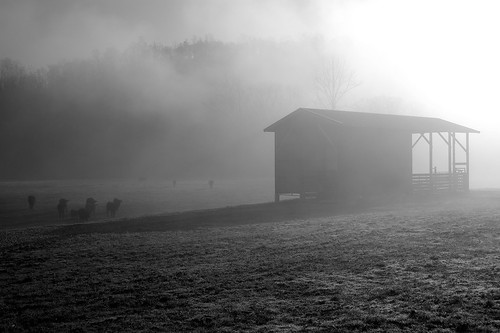
This barn was beautiful with the sun screaming in over the rural KY mountains. As I snapped this picture I noticed the cows were beginning to charge toward me. I think they wanted something to eat.
Other Friday photos: Joe Thorn, Timmy, Alex, Joe K (some of these guys are at a conference in KY, so they may not have a chance to put up a pic today)
Black Boots
Some of you have seen this, but I would guess most of you have not. I watched it again today and it still rocks. A short film starring my children: "Black Boots."
Theopraxis: Theology of the Suburbs
Scott Berkhimer of Theopraxis and MereMission is in suburban Philadelphia. He has written a series of posts on "A Theology of the Suburbs." I've been enjoying his thoughts and felt I should provide a central location for these links here. He offers no specific titles, so I will offer a very brief identifier for each post.
Part 1: Pursuit of Happiness; Part 2: Choice & Imagination;
Part 3: Economic Influence; Part 4: Rootlessness;
Summary: Restatement; Part 5: Race & Ethos 1;
Part 6: Race & Ethos 2; Part 7: Imago Dei & Sabbath Keeping;
Part 8: Shaping Imaginations; Part 9: Simplicity & Generosity
Part 10: Hospitality & Eucharist; Part 11: Suburbs & Gospel
Incarnational Practices
I read this last year, but found it again recently. I don't agree with all of it, but I think it's thought-provoking in a healthy way. "Incarnational Practices."
What Culture War Does to Warriors
CT Online: Furrowed Brows Inc. According to the article, the culture war's biggest casualties may be Christian joy and hope. A blurb...
There was violence and disintegration in the day ofJesus, too. Jesus was hardly shy about confronting the patterns of sin in his culture—though he was consistently harder on the pious than he was on the pagans.
But everywhere Jesus went, life blossomed. The sick were healed, lepers were touched, daughters and sons were plucked from the mouth of the grave. Jesus left behind him a trail of leaps and laughter, reunited families, and terrific wine, as well as dumbfounded synagogue leaders, uneasy monarchs, and sleepless procurators. His witness against violence, amidst a culture in rebellion against the good, was neither withdrawal nor war. It was simply life: abundant, just, generous life. And, ultimately, a willingness to let the enemies of life do their worst, confident that even death could not extinguish the abundant life of God.
Christian Leaders
Mark Dever in A Display of God's Glory quotes the interaction of a Japanese businessman with a visiting Australian (as told by Os Guiness),
Whenever I meet a Buddhist leader, I meet a holy man. Whenever I meet a Christian leader, I meet a manager.
Quotes from The Missional Leader
 I'm reading The Missional Leader by Roxburgh and Romanuk. If I stopped reading now (not yet halfway through), it's still one of the most important books I've read in the last couple of years. I'm sure much of that is because of where I am in ministry and the things I need to think about for my local church. And I don't agree with everything, but I can't say enough about what this book is working in my life and ministry. Here are a few short quotes...
A missional church is a community of God's people who live into the imagination that they are, by their very nature, God's missionary people living as a demonstration of what God plans to do in and for all of creation in Jesus Christ. (p. xv)
Missional leadership is about creating and environment within which the people of God in a particular location may thrive. (p. 6)
Today, we give up on congregations that we declare are out of touch with the culture. We run to big, successful places with marquee-name leaders to find out how to be successful. In so doing we are going in exactly the opposite direction from everything we see in the Biblical narratives. We have forgotten that God's future often emerges in the most inauspicious places. If we let our imagination be informed by this realization, it will be obvious that we need to lead in ways that are different from those of a CEO, an entrepreneur, a super leader with a wonderful plan for the congregation's life. Instead we need leaders with the capacity to cultivate an environment that releases the missional imagination of the people of God. (p. 21)
Phriday is for Photos
in Photography

The bridge from the 18th green to the club house is flooded, but add a sunset and a slower shutter speed and you get a cool effect. This is in Pontiac, IL, my hometown. View this on my Flickr.
Other Friday pics: Joe, Timmy, Alex.
My Photography ||| My Photoblog
On Being Hospitable
Mark Driscoll's sermon on hospitality has been very helpful as my wife and I consider our missional calling in the suburbs/exurbs of Chicago. I encourage you to listen to it.
Exurbs Expanding
in Chicago, Suburb/Exurb, Urban
Census: Americans are Fleeing Big Cities...
Americans are leaving the nation's big cities in search of cheaper homes and open spaces farther out.
Nearly every large metropolitan area had more people move out than move in from 2000 to 2004, with a few exceptions in the South and Southwest, according to a report being released Thursday by the Census Bureau.
Northeasterners are moving South and West. West Coast residents are moving inland. Midwesterners are chasing better job markets. And just about everywhere, people are escaping to the outer suburbs, also known as exurbs.
Here in Woodstock, IL we have layers in our suburban/exurban community. We are our own city where older local residents used to know all the families of Woodstock and where they lived. Many of them are in their 70's and 80's and the city is changing shape.
We are growing rapidly with city dwellers leaving to find affordable housing. Right now we have people in our church who were born here and will die here in the next few years as well as people who have just moved in to get a more "country" feel. Others are moving in and occupying large houses in large, new housing developments and have plenty of money. Most newcomers want less crime, better schools, better marriages, a better retirement, more time for recreation and to generally be left alone.
These are challenging times.
Lost Art
I encourage you to read "The Importance of Art When Engaging Non-Believers" by David Fairchild. Helpful. A blurb...
Since art is both enjoyableand educating, and communicates a message about itself and about the world that it was created in, we should pray that more and more the Christian community will see the need to engage the arts as the primary way to speak intelligently and truthfully to those who are made in God’s image.
Time to Read?
C.J. Mahaney's "A Plan for Reading and Study."
Wise Replaces Dembski
in SBC
Emerging in the Suburbs
David Fitch (at Out of Ur) on "The Brutal Burbs: How the Suburban Lifestyle Undermines Our Mission."
By idolizing the family, suburbanites may become focused onconsuming more stuff to create the perfect home and family. There is nothing but contrived affection left to keep the home together. And children who learn they are the center of this universe from parents actually develop characters that believe they really are the center of the universe.
After decades of this suburban lifestyle America is left with families split by divorce, kids leaving in rebellion, and millions on various drugs to relieve the emptiness as the idolized family turns out to be a myth. Apart from the personal destruction the suburbs can bring, suburban isolation also poses a real problem for the spreading of the gospel.
If hospitality is to be a central way of life for the spreading of the gospel, the alienation of the suburbs is a condition of our exile we must overcome. Elsewhere I have said:
… evangelical Christians must consistently invite our neighbors into our homes for dinner, sitting around laughing, talking, listening and asking questions of each other. The home is where we live, where we converse and settle conflict, where we raise children. We arrange our furniture and set forth our priorities in the home. We pray for each other there. We share hospitality out of His blessings there. In our homes then, strangers get full view of the message of our life. Inviting someone into our home for dinner says “here, take a look, I am taking a risk and inviting you into my life.” By inviting strangers over for dinner, we resist the fragmenting isolating forces of late capitalism in America. It is so exceedingly rare, that just doing it speaks volumes as to what it means to be a Christian in a world of strangers.
iMonk LOVES the Cubs
in Sport

No doubt about it, the iMonk can't get enough of the Cubs. He always wore his Cubs hat around the OBI campus a little half-cocked in order to be "relevant" to the youth. They all thought he was sooooo cool, and they were right! (I was able to retain the cubbie blue and red in post-processing.)
In the middle, Matthew Smith of Indelible Grace. On the right? Ineligible Grace.