Quotes from The Missional Leader

Missional_leader_1I'm reading The Missional Leader by Roxburgh and Romanuk.  If I stopped reading now (not yet halfway through), it's still one of the most important books I've read in the last couple of years.  I'm sure much of that is because of where I am in ministry and the things I need to think about for my local church.  And I don't agree with everything, but I can't say enough about what this book is working in my life and ministry.  Here are a few short quotes...

A missional church is a community of God's people who live into the imagination that they are, by their very nature, God's missionary people living as a demonstration of what God plans to do in and for all of creation in Jesus Christ. (p. xv)

Missional leadership is about creating and environment within which the people of God in a particular location may thrive. (p. 6)

Today, we give up on congregations that we declare are out of touch with the culture.  We run to big, successful places with marquee-name leaders to find out how to be successful.  In so doing we are going in exactly the opposite direction from everything we see in the Biblical narratives.  We have forgotten that God's future often emerges in the most inauspicious places.  If we let our imagination be informed by this realization, it will be obvious that we need to lead in ways that are different from those of a CEO, an entrepreneur, a super leader with a wonderful plan for the congregation's life.  Instead we need leaders with the capacity to cultivate an environment that releases the missional imagination of the people of God. (p. 21)

Exurbs Expanding

Census: Americans are Fleeing Big Cities...

Americans are leaving the nation's big cities in search of cheaper homes and open spaces farther out.

Nearly every large metropolitan area had more people move out than move in from 2000 to 2004, with a few exceptions in the South and Southwest, according to a report being released Thursday by the Census Bureau.

Northeasterners are moving South and West. West Coast residents are moving inland. Midwesterners are chasing better job markets. And just about everywhere, people are escaping to the outer suburbs, also known as exurbs.

Here in Woodstock, IL we have layers in our suburban/exurban community.  We are our own city where older local residents used to know all the families of Woodstock and where they lived.  Many of them are in their 70's and 80's and the city is changing shape. 

We are growing rapidly with city dwellers leaving to find affordable housing.  Right now we have people in our church who were born here and will die here in the next few years as well as people who have just moved in to get a more "country" feel.  Others are moving in and occupying large houses in large, new housing developments and have plenty of money.  Most newcomers want less crime, better schools, better marriages, a better retirement, more time for recreation and to generally be left alone.

These are challenging times.

Lost Art

I encourage you to read "The Importance of Art When Engaging Non-Believers" by David Fairchild.  Helpful.  A blurb...

Since art is both enjoyableand educating, and communicates a message about itself and about the world that it was created in, we should pray that more and more the Christian community will see the need to engage the arts as the primary way to speak intelligently and truthfully to those who are made in God’s image.

Emerging in the Suburbs

David Fitch (at Out of Ur) on "The Brutal Burbs: How the Suburban Lifestyle Undermines Our Mission."

By idolizing the family, suburbanites may become focused onconsuming more stuff to create the perfect home and family. There is nothing but contrived affection left to keep the home together. And children who learn they are the center of this universe from parents actually develop characters that believe they really are the center of the universe.

After decades of this suburban lifestyle America is left with families split by divorce, kids leaving in rebellion, and millions on various drugs to relieve the emptiness as the idolized family turns out to be a myth. Apart from the personal destruction the suburbs can bring, suburban isolation also poses a real problem for the spreading of the gospel.

If hospitality is to be a central way of life for the spreading of the gospel, the alienation of the suburbs is a condition of our exile we must overcome. Elsewhere I have said:

… evangelical Christians must consistently invite our neighbors into our homes for dinner, sitting around laughing, talking, listening and asking questions of each other. The home is where we live, where we converse and settle conflict, where we raise children. We arrange our furniture and set forth our priorities in the home. We pray for each other there. We share hospitality out of His blessings there. In our homes then, strangers get full view of the message of our life. Inviting someone into our home for dinner says “here, take a look, I am taking a risk and inviting you into my life.” By inviting strangers over for dinner, we resist the fragmenting isolating forces of late capitalism in America. It is so exceedingly rare, that just doing it speaks volumes as to what it means to be a Christian in a world of strangers.

iMonk LOVES the Cubs

Dsc_00462_crop_500_cubs

No doubt about it, the iMonk can't get enough of the Cubs.  He always wore his Cubs hat around the OBI campus a little half-cocked in order to be "relevant" to the youth.  They all thought he was sooooo cool, and they were right!  (I was able to retain the cubbie blue and red in post-processing.)

In the middle, Matthew Smith of Indelible Grace.  On the right?  Ineligible Grace. 

Matthew Smith

Dsc_00421It was great to have Matthew Smith at the OBI conference on Tuesday night and Wednesday morning.  If you don't know about Matthew, he is one of the main guys at Indelible Grace.  They take really old hymns (most are 200-300 years old or so) and rework or rewrite the music.  Fantastic stuff.  I've been listening to IG for 3-4 years and love it.  I've also been keeping up with Matthew's blog for some time.  He is a member of City Church in East Nashville.

While there I bought the new IG CD (their fourth) and Matthew's CD "Even When My Heart is Breaking" which is available on iTunes or you can order it on his website.

Matthew played for over an hour on Tuesday night and for 30 minutes on Tuesday morning.  I also got to spend time talking with him on Wednesday for lunch.  Really good guy who I recommend for his voice, his music, his heart, and his deep love of Jesus and the Gospel.  I have rarely heard a Christian singer who understands the Gospel so well.

You can also read about Matthew from my buddy Wes who heard Matthew in concert on Wednesday night in Lexington, KY.

Phriday is for Photos

Work is Finished

On the road back from Kentucky we passed a smorgasbord of old rusted farm equipment.  These two tractors were some of the most interesting pieces there, and made for a nice colorful picture. 

Also check out Timmy's Pic of the Week as well as Alex Forrest's pic.  Glad Alex has joined in our Friday fad.  I'll put a link to Joe Thorn's when he puts up his pic.  Joe said he hates me and doesn't want to put a pic up today.  Actually he has some server issue, the big baby. He just called me from a corn field. :)

Back Home

Dsc_00471We're home after a very long day of driving.  I have many new pictures from the trip, though most are more art focused than "moments to remember."  God's grace sent us to the Louisville P.F. Changs for lunch.  My parents bought us pizza for dinner as we stopped through Pontiac, IL to retrieve our cat (Calvin).  It was an exhausting day after an exhausting week, but we are so encouraged by what God has done to us and through us on this great trip.

More tomorrow.

While I Was Away...

Having a great trip to OBI in the Kentucky "sticks."  God is doing some great things as I preach.  Students are responding to the Gospel.  I'm tired, physically and emotionally, but the words keep coming.  Awesome stuff.  I should be home and posting again on Friday.  Here's a pic just outside the front door of where we are staying.

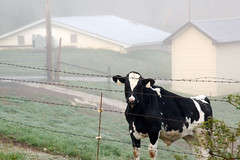
Uh, Moo!

Michael Spencer (the iMonk) is a great host.  I'm at his house right now on his wi-fi.  If you read his online stuff, he's everything you think he will be.  Well, all but the Kentucky twang.  Actually he has presented me with a very prestigious award.  I'm honored.

In other news...

William Dembski leaves SBTS for SWBTS.

Dan at Eucatastrophe has some Keller quotes.

In Lexington, KY

We are in Lexington, KY in a Residence Inn.  Nice.  Our good buddy hooked us up with a sweet room for like $100 cheaper than if we got it ourselves.  We are headed tomorrow to Oneida, KY where I speak at the OBI commitment week.

Tonight we spent time with my good buddy and former pastor, Kyle McClellan and his family.  Then we had dinner at Ruby Tuesdays with Wes, Nick, Julie, Isaac and Kyle.  I've never had so many things go wrong at dinner, and may post more details on that soon (if I feel I need to vent).  But the company was great.  Van joined all of us for conversation after dinner with the guys hanging out first at Coffee Times (skim moka cap) and the ladies at the hotel with the kiddos.  Then we all merged at the Inn for conversation to about 1am with an Ale 8 chaser.  Yeah buddy.  It was a great time with good friends who we first met while they were studying at the University of Kentucky.  I haven't laughed that hard in some time, usually over some of Wes' hilarious comments about cardiologists.

Today we drove for 7+ hours, dropped a few bills at the SBTS bookstore (it's all about the Hamiltons, baby), spent some change at Ear-x-tacy in Louisville (which is a fantastic independent music store), ate at Stevens & Stevens Delicatessen (the Woody Allen and garlic roasted potatoes), and spent a ton of time hanging and talking with friends.

I may not be able to update much over the next few days, but if/when I get on for a minute I'll try to let you know how things are going.  My first talk at OBI is Sunday night at 7pm.  Then Monday through Wednesday I speak at morning chapel and then in the evening at 7pm (except I don't speak Wednesday chapel).  If you think about it, please pray for me and the students at OBI.

Post-Reformed

Growing discussion on being post-reformed.  See The Craw and PostReformed.  Some very good stuff here.  These seven "Being PostReformed..." statements come from The Craw but compiled together at PR...

  1. Being PostReformed means laying aside a dogmatic application of a particular reading of the Reformed Confessions that keeps one from appreciating and fellowshipping with brethren from other traditions outside of Reformedom.
  2. Being PostReformed enables one to see the Bible as God’s grand story of the ages and not to view it as a repository of propositions and factoids. It’s not a Tommy-gun that we load up with pet proof texts…to blast other Christians with. It sometimes gets mysterious and messy but the PostReformed man is comfortable with that and doesn’t feel the necessity to correct God via better formulations and propositions.
  3. Being PostReformed allows one to ask, “who can I work with” rather than “who can I not work with” in ministry opportunities outside of one’s immediate church, denomination, or tradition. This puts things in positive rather than negative terms and frees one to find allies instead of drawing an ever more exclusive circle of “orthodoxy.”
  4. Being PostReformed means that when one arrives at a roadblock in one’s tradition, a roadblock created by traditions that attempt to interpret tradition,     one is free jump into another road altogether. The PostReformed are not afraid to borrow from another tradition’s formulation of an issue, or to leave a particular point to ambiguity. He is able to clearly see he is bound by God’s Word and that tradition must serve it. He is a man in full.
  5. Being PostReformed means that you are sometimes not persuaded when the majority of current scholarship in your tradition agrees on something. They may be blind to the fact that they have arrived in a self-referential cul-de-sac. Jumping out of the cul-de-sac to see what another tradition says or to access earlier formulations from your own tradition isn’t something to be afraid of.
  6. Being PostReformed means you regard Arminians, Emerging Churchmen, and Roman Catholics as Christians…and treat them as such. You work vigorously to build unity, without compromising truth, to demonstrate the visible unity of the Body of Christ, wherever you can, to the watching world. The PostReformed man takes the Beatitudes seriously with great longing in his heart: “Blessed are the peacemakers for they shall be called the sons of God.”
  7. Being PostReformed means having enough confidence in your Reformed theological convictions that you can interact substantively with Christians in other traditions without fear. The fear that often masquerades as dogmatism is replaced by a love for the truth and your brethren.

Keller: Preaching to Believers/Unbelievers

Tim Keller gave a lecture at Covenant Seminary in 2004 on Preaching to Believers and Unbelievers.  He deals with a few very important points.  One of them is about the power of the preaching event over the moralistic application of the sermon (evidenced by taking notes).  I have quoted Keller on this issue recently.  He also deals with Deconstructing Defeater Beliefs in the lecture.  Give it a listen.

McNeal on Spiritual Formation

I've been thinking a bit about spiritual formation lately, and this lengthy quote from Reggie McNeal has been helpful.  I am almost done with this book and I've really enjoyed it.

In the modern world spiritual formation was thought to be accomplished by taking a student through a prescribed group of texts that addressed topic in a curricular approach.  This is so deeply ingrained in us that we approach almost any learning experience in the church this way.  Only in the modern world would you find people huddled together reading literature produced by mission agencies as a primary approach to mission "education" or would you convene a conference for people to spend all day taking notes in a notebook on fasting and prayer.  This feels "normal" to us.  In the world that is dawning, the curriculum approach to growing people is increasingly view as a supplemental strategy to the primary approach: learning agendas driven by life issues and informed by life experiences.

Jesus facilitated spiritual formation in his disciples by introducing them to life situation and then helping them debrief their experiences.  He taught them to pray.  He did not lead them in a study course on prayer.  He took them on mission trips (Samaria, for example); he didn't read books to them on the subject of missions.  He sent them on learning junkets and exposed them to situations.  He asked their opinion on what they were hearing and observing ("Who do you say that I am?").  He asked for radical obedience from them.  He asked them to take up a cross and follow him.  He did not send them to school and wait for them to graduate before giving them a significant assignment.  He sent them out before they were ready to go and then helped them to learn from their experiences.  He talked about the kingdom of God, but mostly he lived the kingdom of God, practicing a life in front of his followers that modeled very different core values than those given to them by the Pharisees in the synagogues.

Helping people grow, particularly in the arena of spiritual formation, is about unpacking life: challenging our emotional responses that are destructive (envy, hatred, bitterness); challenging our biases (racial prejudice, social and economic elitism, intellectual snobbery); challenging our assumptions ("my needs are the most important"); challenging our responses; unpacking our frustrations, our hopes, our dreams, and our disappointments; bringing life to God rather than teaching about God, somehow hoping to get him into our life.

Reggie McNeal in The Present Future, pgs 85-86, emphasis his.